


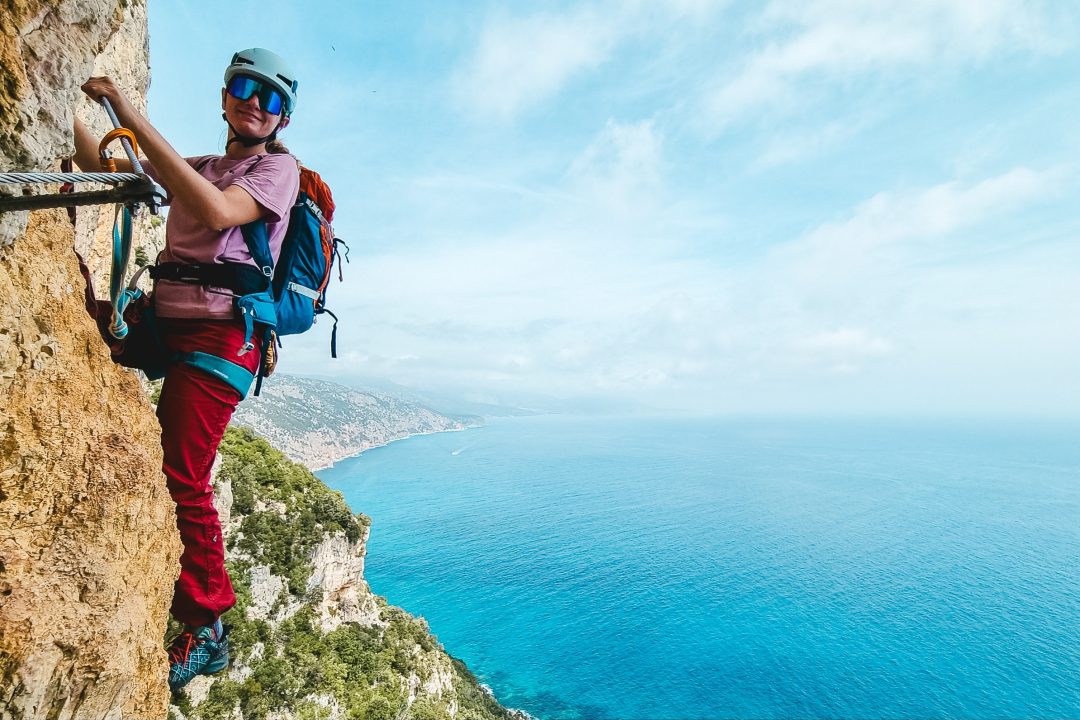
For the last ten years I have been leading groups to discover Selvaggio Blu, known as Italy’s most demanding trek. From the very beginning I have always offered the version that Marcello Cominetti calls “VISTA MARE”; I learned it from him, just as I learned from him the idea that Selvaggio Blu must be an experience that is as unique as it is uncomfortable, with no luggage or tents following along. On the third day, Selvaggio Blu “Vista Mare” tackles a more demanding route than the original, passing through Su Ledere and the Goloritzé via ferrata, bypassing the Boladina Gorge which would pointlessly lead toward Punta Mudaloru before descending back toward the sea.

The 55-metre abseil at Punta Plummare. Selvaggio Blu Extreme.
The introduction of the Goloritzé variant in 2013 reshuffled the offerings of guides and agencies for Selvaggio Blu; someone began calling the version with the Goloritzé via ferrata and a few other spectacular abseils “Selvaggio Blu Extreme”. Other colleagues then began offering the route in reverse, still 5 days of walking, starting from Margine along the S’Istrada Longa to Cala Goloritzé, calling it “Blu Selvaggio” or “Selvaggio Blu Extreme”. The new Versante Sud guide “Il Supramonte di Baunei e il Selvaggio Blu” calls this version “Filu Pendere”, and explains the itinerary in good detail across its 5 stages.
I have always looked at this reverse version with a hint of suspicion, thinking that the original is always the best, a bit like those cult classics that get sequels. Is it possible to make Selvaggio Blu in reverse appealing not only to those who have never explored this magnificent stretch of the Ogliastra coast, but also to those who have already walked the normal itinerary or the Vista Mare? In the autumn of 2021 — partly out of a desire to change and discover new stages, partly because I wanted to bring my first “savages” (far more more confident today after so many great adventures together in the Dolomites and across the Alps) to set foot on Sardinia once again— we went to see the most exciting stages of this “Selvaggio Blu Extreme”. And I can tell you it literally bewitched us. From Cala Sisine to Cala Goloritzé, each stage is more beautiful and more exciting than the last. Each has its own reason for being. The exposed via ferrata section, the dizzying abseil, the most beautiful beach, the incredible cave, the most exposed ledge…

Crawling along the impressive crack of Punta Mudalloru. Selvaggio Blu Extreme, fourth stage.
This “Extreme” version does not feature distinctly hiking-oriented days, nor ones with large positive elevation gains. The first stage, along the S’Istrada Longa, is perhaps the only one, but it is all downhill, so you don’t need to be overly fit.
For 2027 I will introduce a couple of new features. The itinerary will no longer end at Cala Goloritzé, but at Pedra Longa, to give the chance to experience the hospitality and cooking of Laura and Salvatore at their sheepfold in Irbidossili, and to conclude the trek with a few last spectacular abseils at Punta Giradili and an exploration of a rarely visited cave.
Safety is always guaranteed on the most demanding sections, thanks to the rope fixed by the mountain guide wherever one is not already present. To take part, excellent hiking experience is always required (being able to cope on any type of terrain), good fitness (an average of 6 hours of walking per day, maximum elevation gain around 800 metres, all at a normal pace), sure footing and no suffering from vertigo, and above all excellent adaptability and team spirit. Experience with via ferratas and double-rope abseils is not mandatory but recommended.
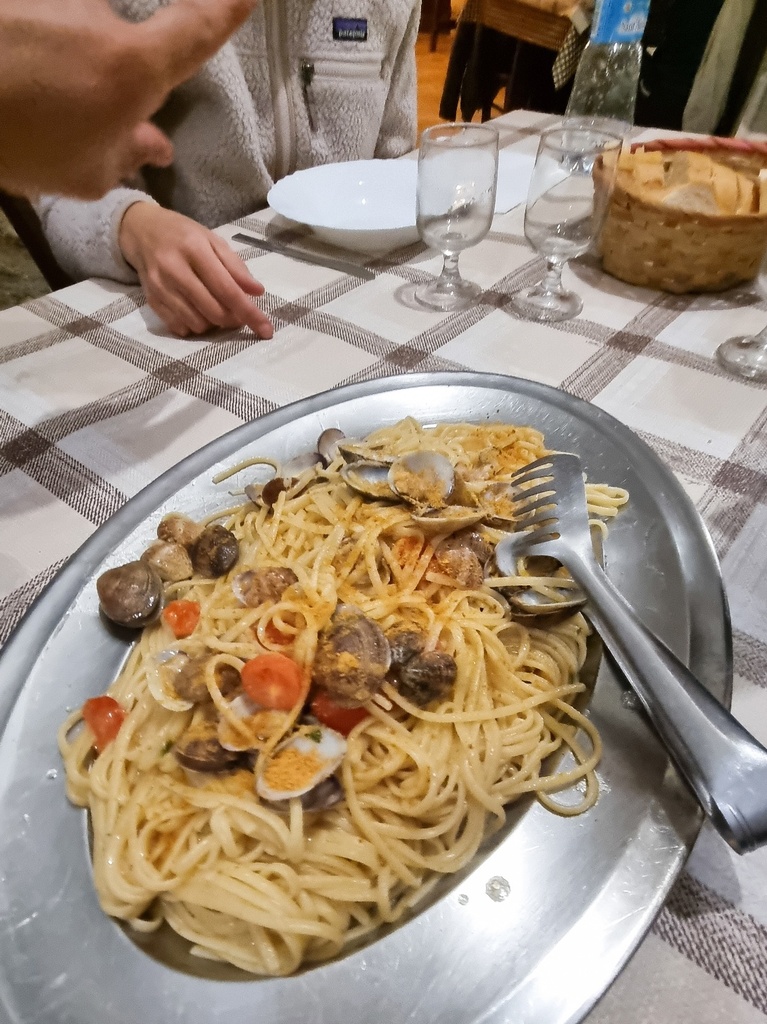
At dinner at Su Coile di Sisine. Selvaggio Blu Extreme.
The overnight stays during the trek will always be “à la belle étoile”, with two nights in a managed sheepfold. On Selvaggio Blu Extreme it is more convenient to move with a light backpack, having what is needed for the night brought to you in the evening, along with the food and water needed for dinner, breakfast and the following day’s picnic.
DEPARTURE 2027: 24-30 MAY and 25-31 OCTOBER. 7 days, of which 5 are trekking. LIMITED PLACES! (MIN. GROUP 6 PEOPLE)
The participation fee includes: mountain guide service, 2 nights in a *** hotel with half board (double and triple rooms, single room on request with supplement), two nights in a managed sheepfold with half board (starter, first and second course and dessert, drinks included), breakfast, lunch and dinner for the entire duration of the itinerary, transport of luggage at each stage (by luggage I mean sleeping bag, mat and a few spare clothes, NOT SUITCASES), boat pickup at the end of the trek (or by jeep depending on sea navigability), daily water and food supplies, technical equipment if necessary (helmet, harness, lanyard, carabiner).
I am also available to accompany private groups (min. 6 participants) in the two spring periods (from April to late May) and autumn periods (from September to early November).

The Plumare via ferrata, Selvaggio Blu Extreme, Second stage.
GENERAL PROGRAMME
First day: the meeting is set for 6 pm at the Albergo Santa Maria, in Santa Maria Navarrese. Before dinner, introduction to the trek, briefing and gear check.

S’Istrada Longa. In the background, the section with the characteristic exposed ledge.
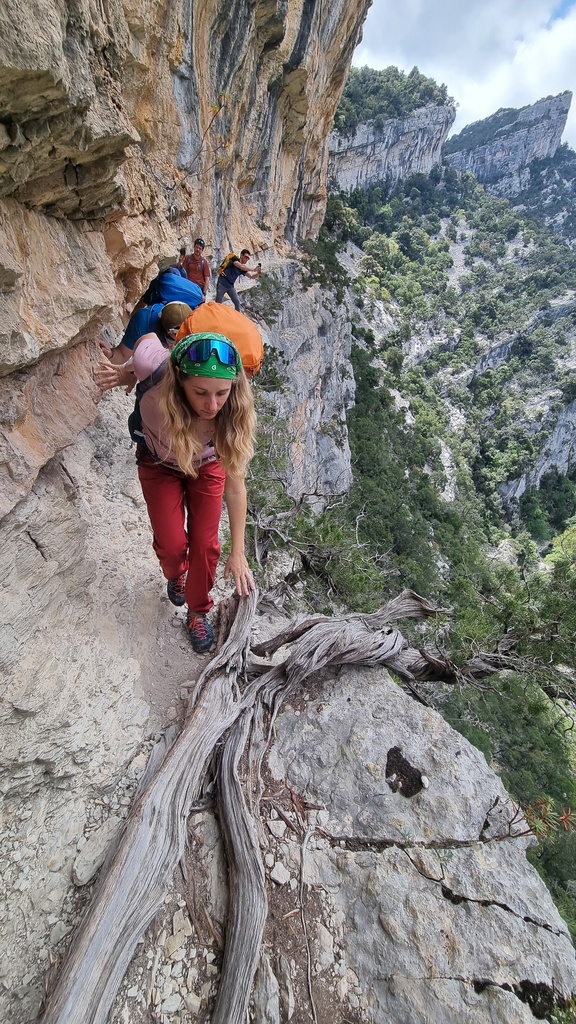
The key section of S’Istrada Longa. Selvaggio Blu Extreme.
Second day: we leave the hotel by off-road vehicle for a transfer of about 1 hour and a half to the Margine locality, in the Supramonte di Baunei. It is a day of descent, but only in terms of elevation. An initial open-field section is followed by a descent along the Baccu Addas; the start of the S’Istrada Longa is at a large drop. The track narrows more and more until it becomes a true ledge, very exposed in one section. A characteristic wooden charcoal-burners’ bridge, rebuilt in the 1970s, leads down to the valley floor as far as Plan’e Murta, where we continue for another twenty minutes or so to reach Cala Sisine for a first refreshing swim. 4-5h of walking, overnight stay at “Su Coile” near the beach, with a typical dinner (of land or sea).
Third day: we get to the heart of the adventure. For those who have already done classic Selvaggio Blu, we resume the walk right where they left off. We cover the 250 metres of elevation gain planned for the stage right in the first part. Having put on the harness at a fine panoramic spot, we begin following an old charcoal path that narrows more and more until it becomes a slender track. A first short abseil allows us to continue the walk to the first metal cables. The vegetation and the place where we walk are incredible; a cave with vivid orange sand recalls photos of Mars!

Setting up the double-rope abseil on Cala Biriala. Ph. Tremolada.
The key section is shortly after: a 20-metre wall equipped with cable and via ferrata bolts allows us to overcome a yellow, vertical wall with no holds. We continue with other equipped sections, always exposed, until we reach the first real abseil of the day, 35 metres almost vertical, to reach a ledge followed by one of the longest abseils of the trek, 55 metres, vertical at first and then completely in the void. After a well-earned picnic, we continue along the Classic Selvaggio, crossing the Plumare landslide to enter the Oronnoro wood. Cala Biriala is not so far; we will reach the beach with a magnificent 45-metre abseil. After a refreshing swim, we climb back up toward Bacu Padente, along faint trails, a long abseil and an old staircase. 7h of walking.
Fourth day: another adventure awaits us today. From our stage point we descend along the Bacu Padente to the entrance of a cave to explore; with a couple of abseils we return to the classic Selvaggio Blu. The path alternates with sections of staircases, scrambles and a few abseils, up to the classic porthole passage.

The abseil in front of the entrance to the underground cave. Selvaggio Blu Extreme, fourth stage.
We will pass through it; the wall of Punta Mudaloru, with the key section of the stage, is in front of us. A charcoal path leads us to the bottom of Bacu Mudaloru; from here a small track takes us to the base of yet another technical section of the day. A traverse on an exposed wall followed by two juniper trunks, firmly resting on a vertical yellow-grey dihedral. It is the start of the horizontal crack; it awaits us behind the corner.
Here you absolutely must crawl, pushing your backpack ahead of you; adrenaline is high (and so is safety, thanks to a rope fixed by the guide). We continue our march through the wild wood of Ispuligi; we reach a characteristic panoramic balcony, where we find the propped juniper trunk of Su Fronte de As Postas, a very rarely frequented shepherds’ path that leads to the top of Serra e Lattone. Cala Mariolu is below us; we still have to follow the goat tracks along an exposed ledge and two double-rope abseils, the last of almost 60 metres dropping us directly onto the rocks a few metres from the white pebbles of the beach. 7-8h.

Along the horizontal ledge of Punta Plummare. Selvaggio Blu Extreme.

Selvaggio Blu Extreme, sixth day. The Giradili abseils. Ph. Cosi
Fifth day: after a fine breakfast kissed by the sun, today we will reach Cala Goloritzé by walking the demanding Su Ledere ‘e Goloritzé in reverse, equipped by Marcello Cominetti and the Explorando Supramonte team in 2014. From the bivouac spot at Cala Mariolu we follow a comfortable path until we spot the remains of a charcoal path that cuts horizontally through the wood to the edge of the cliff where the metal cable of the Goloritzé via ferrata emerges. We abseil down along it, until we reach the wood and a stony area. We cross 3 steep landslides, partly with the help of fixed ropes, before reaching the white slab above Cala Goloritzé. The last abseil of our adventure awaits us before well-earned relaxation and a refreshing swim.
The climb of the Guglia di Goloritzè, reserved for experienced climbers (minimum level required 6a+), is the real icing on the cake. Easy Gymnopedie (6b+ max) can be described as the hardest normal route in Italy. The ascent takes a couple of hours, and it is possible to organise it during the day.
In the afternoon we climb back up the tourist path of Cala Goloritzé for a good half hour, until we meet the Selvaggio Blu path descending from Punta Salinas. A comfortable uphill dirt road will take us to the sheepfold of Salvatore and Laura, where we will enjoy a well-earned rest and an excellent typical dinner.

Along the Goloritzé via ferrata. Selvaggio Blu Extreme, last stage.
Sixth day: the last day of trekking. Along a comfortable dirt road we reach the Us Piggius sheepfold, the stage point of Classic Selvaggio Blu, and we take the Cengia Giradili downhill until we reach a line of abseils that will take us to explore the S’Erriu Mortu Cave. Pedra Longa is now close; barely an hour more of walking and we will reach its base to return to Santa Maria Navarrese by rubber dinghy. Time for an ice cream in town and then a dash under a nice shower at the hotel. Dinner and overnight stay at the hotel.
Seventh day: group disbanding after breakfast at the hotel.
EQUIPMENT:

Climbing the old juniper staircase of the third day. Selvaggio Blu Extreme.
– Backpack 40-50L (for years I have used an Arcteryx AFL 40; it is an expensive backpack but indestructible, genuinely waterproof, even after intensive use in the mountains)
– Medium-lightweight sleeping bag (comfort temperature around 5-10 degrees; don’t bring old sleeping bags that take up loads of space and leave you cold. Personally I can recommend the SeaToSummit SPII, which is even too warm)
– Polyurethane or self-inflating mat (if you feel like spending a little extra, I recommend the Thermarest NeoAir Xlite; it is extremely comfortable, extremely light and takes up minimal space in the backpack. Otherwise the Forclaz from Decathlon costs little and offers more or less the same service)
– Harness (a light glacier / ski-mountaineering type is sufficient), two wide-base screwgate carabiners, a 3-metre length of full rope 9-9.5mm. Alternatively a via ferrata kit is also fine. Belay device for the abseils.
– Climbing helmet
– Headlamp
– Cup, plate, cutlery (if you need to buy, the Sea To Summit brand sells excellent silicone products perfect for camping; Decathlon plastic cutlery is perfectly fine)
– Broken-in trekking shoes, preferably low-cut (not trail running shoes, they get destroyed). Mountaineering boots are not necessary (any flip-flops/sandals for the evening are recommended to let your feet breathe)
– Light Gore-Tex jacket
– Light down jacket (like the Patagonia Down Sweater, even sleeveless)
– Cotton sweatshirt or light fleece
– 2 T-shirts, preferably white or at any rate light-coloured.
– Sturdy canvas trousers and shorts
– Socks and underwear (I recommend a pair of socks per day)
– Swimsuit
– Buff-style bandana
– Hat, sunscreen and sunglasses
– Insect repellent
– Towel and toiletries (the large microfibre towel from Decathlon is perfect)
– Trekking poles not essential and only if foldable (Leki, Black Diamond and Gipron among the most common)
– External battery to charge your phone (there is always signal in the evening when we are on the beach; a 10000mAh battery is more than enough)
– Water bottles are not needed!
Your personal luggage stays safe at the hotel during the trek.

Cala Biriala, Selvaggio Blu Extreme. Ph. Tremolada
INFORMATION ON REACHING SANTA MARIA NAVARRESE FROM ITALY

Ready to return to Santa Maria! Selvaggio Blu Extreme, sixth day.
Nowadays, with low-cost airlines, reaching Sardinia by ferry is not so convenient, especially if you have no plans to spend additional time travelling around the island. By booking early and looking at the options from the various airports, you can fly for as little as 40 euros, and in any case never more than 120 euros return including checked baggage. We always try to organise a collective transfer for participants arriving at Cagliari airport (preferred) or Olbia. Otherwise you can reach Santa Maria Navarrese by scheduled bus (allow 3-4 hours). From Cagliari airport the train takes you into the city centre, and next to it you will find the bus station. With a single change at Tortolì you reach the town of Santa Maria Navarrese. You can also rent a car for the whole week, with GoldCar (which I recommend and always use), although since Covid the prices are no longer so convenient. In any case, the car then stays safe in the hotel car park during the trek. I remain available for any detail and information about this.
-

- S’Istrada Longa. Selvaggio Blu Extreme DAY 1.

-

- S’Istrada Longa. Selvaggio Blu Extreme DAY 1.
-

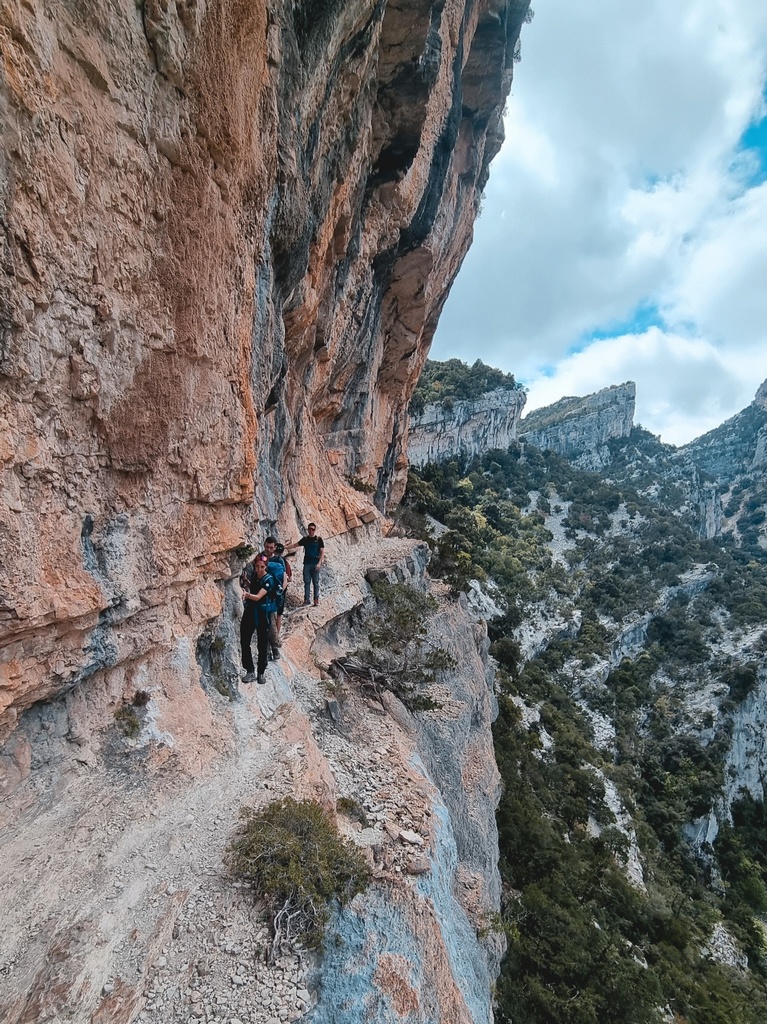
- S’Istrada Longa. Selvaggio Blu Extreme DAY 1.
-

- S’Istrada Longa. Selvaggio Blu Extreme DAY 1.

-

- Linguine with bottarga and clams as a first course on our dinner at Su Coile. Selvaggio Blu Extreme, Day 1.
-

- Selvaggio Blu Extreme. DAY 2

-

- Selvaggio Blu Extreme. DAY 2

-

- Selvaggio Blu Extreme. DAY 2

-

- Selvaggio Blu Extreme. DAY 2

-

- Selvaggio Blu Extreme. DAY 2

-

- Selvaggio Blu Extreme. DAY 2

-

- Selvaggio Blu Extreme. DAY 2

-

- Selvaggio Blu Extreme. DAY 2

-

- Selvaggio Blu Extreme. DAY 2

-

- Selvaggio Blu Extreme. DAY 2

-

- Selvaggio Blu Extreme. DAY 2

-

- Selvaggio Blu Extreme. DAY 2

-

- Selvaggio Blu Extreme. DAY 2

-

- Selvaggio Blu Extreme. DAY 2

-

- Selvaggio Blu Extreme. DAY 2

-

- Selvaggio Blu Extreme. DAY 2

-

- Selvaggio Blu Extreme. DAY 2

-

- The long rappel on Monte Plummare. Selvaggio Blu Extreme, day 2.

-

- Selvaggio Blu Extreme. DAY 2

-

- Selvaggio Blu Extreme. DAY 2

-

- Selvaggio Blu Extreme. DAY 2

-

- Selvaggio Blu Extreme. DAY 2

-

- Selvaggio Blu Extreme. DAY 2

-

- Selvaggio Blu Extreme. DAY 2

-

- Selvaggio Blu Extreme. DAY 3

-

- Selvaggio Blu Extreme. DAY 3

-

- Selvaggio Blu Extreme. DAY 3

-

- Selvaggio Blu Extreme. DAY 3

-

- Selvaggio Blu Extreme. DAY 3

-

- Selvaggio Blu Extreme. DAY 3

-

- Selvaggio Blu Extreme. DAY 3

-

- Selvaggio Blu Extreme. DAY 3

-

- Selvaggio Blu Extreme. DAY 3

-

- Selvaggio Blu Extreme. DAY 3

-

- The abseil in front of the entrance to the underground cave. Selvaggio Blu Extreme, fourth stage.

-

- Selvaggio Blu Extreme. DAY 3

-

- Selvaggio Blu Extreme. DAY 3

-

- Selvaggio Blu Extreme. DAY 3

-

- Selvaggio Blu Extreme. DAY 3

-

- Selvaggio Blu Extreme. DAY 3

-

- Selvaggio Blu Extreme. DAY 4

-

- Selvaggio Blu Extreme. DAY 4

-

- Selvaggio Blu Extreme. DAY 4

-

- Selvaggio Blu Extreme. DAY 4

-

- Selvaggio Blu Extreme. DAY 4

-

- Selvaggio Blu Extreme. DAY 4

-

- Selvaggio Blu Extreme. DAY 4

-

- Selvaggio Blu Extreme. DAY 4

-

- Selvaggio Blu Extreme. DAY 4

-

- Selvaggio Blu Extreme. DAY 5

-

- Selvaggio Blu Extreme. DAY 5

-

- Selvaggio Blu Extreme. DAY 5

-

- Selvaggio Blu Extreme. DAY 5

-

- Selvaggio Blu Extreme. DAY 5


